Key Takeaways
- The depth scale runs from level 1 (black) to level 10 (platinum blonde) and is the starting point for every colour diagnosis
- Underlying pigment shifts as hair lightens: reds and red-orange at levels 1–4, orange at levels 5–7, yellow at levels 8–10
- The colour wheel governs neutralisation: blue cancels orange, violet cancels yellow, green cancels red
- The international reflect code (0–7) is the standard shorthand used across professional colour brands
- Understanding these charts lets you predict results, build bespoke formulas, and rescue colour corrections with confidence
Professional hair colouring is built on a predictable logic. Once you understand how hair colour science works, how melanin breaks down under lightener, how underlying pigment influences the final result, and how complementary colours cancel each other out, you stop guessing and start formulating. This guide brings together the core reference charts used in UK salons, with practical worked examples for the situations your clients will actually bring to you.
Whether you're working towards your NVQ Level 2 in Hairdressing or refreshing your technical knowledge as a working colourist, these charts and methods apply directly to your daily practice.
Hair structure and melanin types
Every colour decision starts with understanding what you're working with. Hair is composed of three layers: the cuticle (overlapping protective scales on the surface), the cortex (the main body of the hair shaft where pigment lives), and the medulla (a hollow core present only in coarser hair types). All colour change, whether lightening or depositing, occurs in the cortex.
There are two families of natural pigment in the cortex:
- Eumelanin: large, dark brown-to-black granules responsible for darker shades. Most concentrated at levels 1–4, these dissolve first during the lightening process.
- Pheomelanin: smaller yellow-to-red granules responsible for lighter and red shades. Dominant at levels 5–10, they are more resistant to bleach and persist longer, producing the warm underlying tones that hairdressers must work with or against.
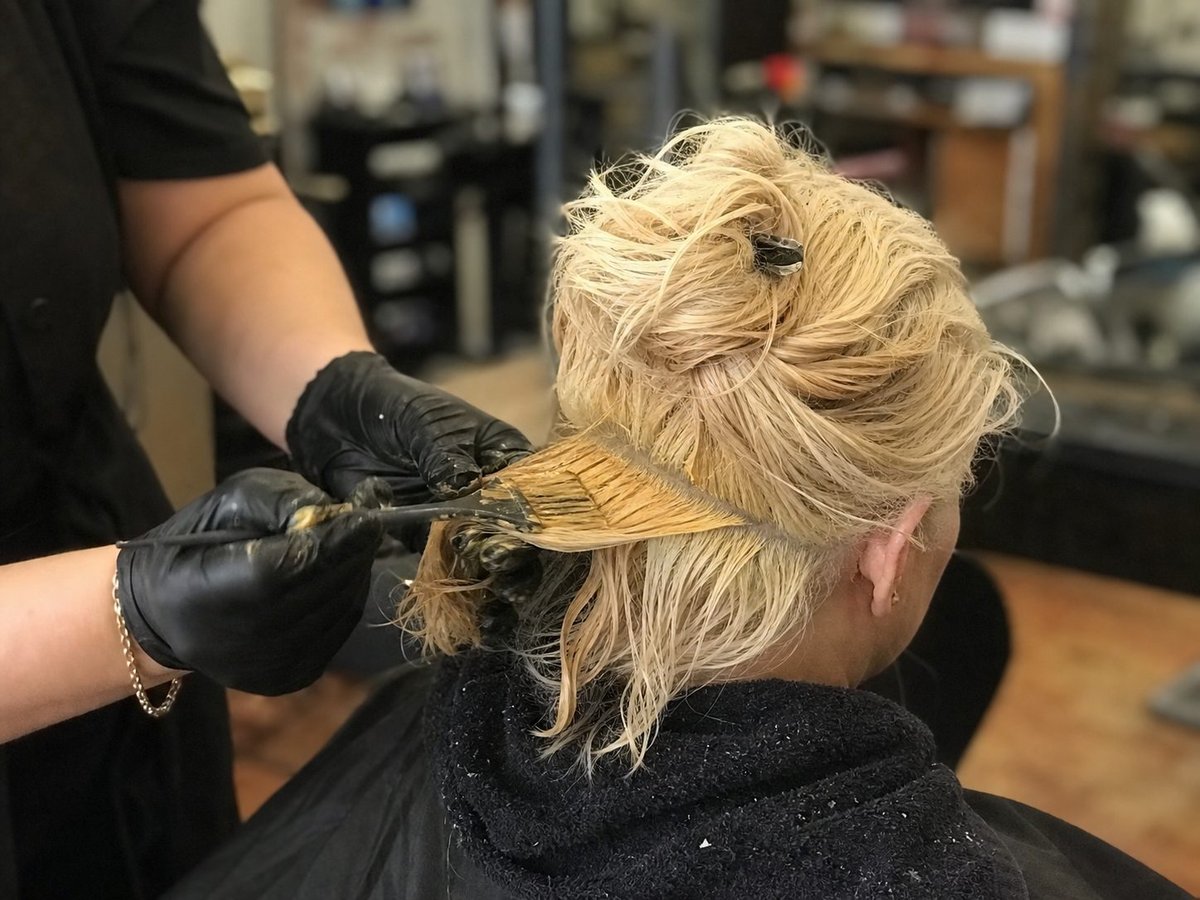
When you apply a lightening product, the alkaline swells the cuticle and the peroxide oxidises the melanin. Large eumelanin granules break down first, then the smaller pheomelanin molecules follow at a slower pace. This staged dissolution is why a dark base doesn't go straight to pale yellow in one application, it passes through a predictable spectrum of warm tones, each one corresponding to a specific depth level.
Depth levels and underlying pigment chart
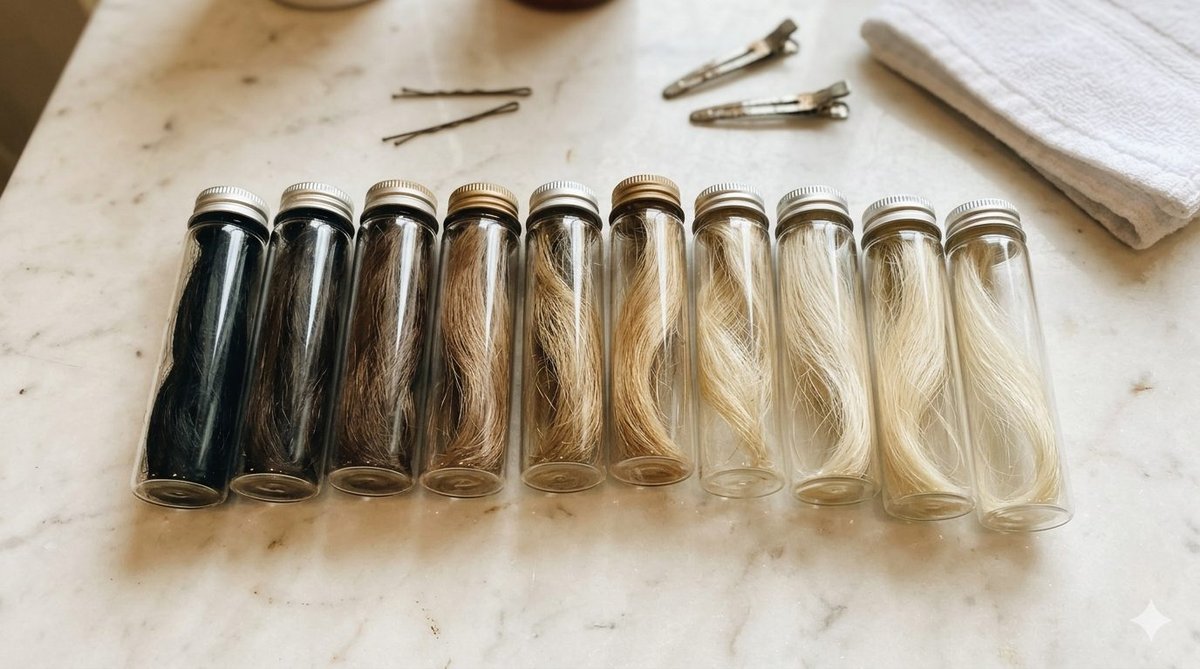
The depth scale, universally numbered 1 to 10, is the shared language of professional colourists. Every hair brand in the UK, from Wella Professionals to Schwarzkopf Professional, bases its numbering system on this same scale. Level 1 is the deepest black; level 10 is the lightest platinum blonde.
Complete reference chart
| Level | Natural colour | Underlying pigment | Dominant pigment type |
|---|---|---|---|
| 1 | Jet black | Deep red | Eumelanin (large granules) |
| 2 | Very dark brown | Red | Eumelanin |
| 3 | Dark brown | Red-orange | Eumelanin dominant |
| 4 | Medium brown | Orange-red | Eumelanin + pheomelanin |
| 5 | Light brown | Orange | Pheomelanin dominant |
| 6 | Dark blonde | Orange-yellow | Pheomelanin |
| 7 | Medium blonde | Yellow-orange | Pheomelanin (medium granules) |
| 8 | Light blonde | Yellow | Pheomelanin (small granules) |
| 9 | Very light blonde | Pale yellow | Trace pheomelanin |
| 10 | Platinum blonde | Very pale yellow | Minimal pigmentation |
Practical example: a client with natural level 4 (medium brown) hair who wants a light blonde (level 8) result will pass through underlying pigments of orange-red → orange → orange-yellow → yellow before arriving at the target. Each of those underlying stages must be factored into your formula or pre-lightening plan.
Why underlying pigment matters for the final result
If you apply an ash tone (which contains blue) onto an orange underlying pigment, you get a muddy result, blue and orange mixed together produce a dirty grey-brown rather than a clean cool ash. The underlying pigment must either be lightened further until it is compatible with your chosen reflect, or neutralised as part of your colour formula. Ignoring it is the single most common cause of colour corrections in UK salons.
The colour wheel and neutralisation
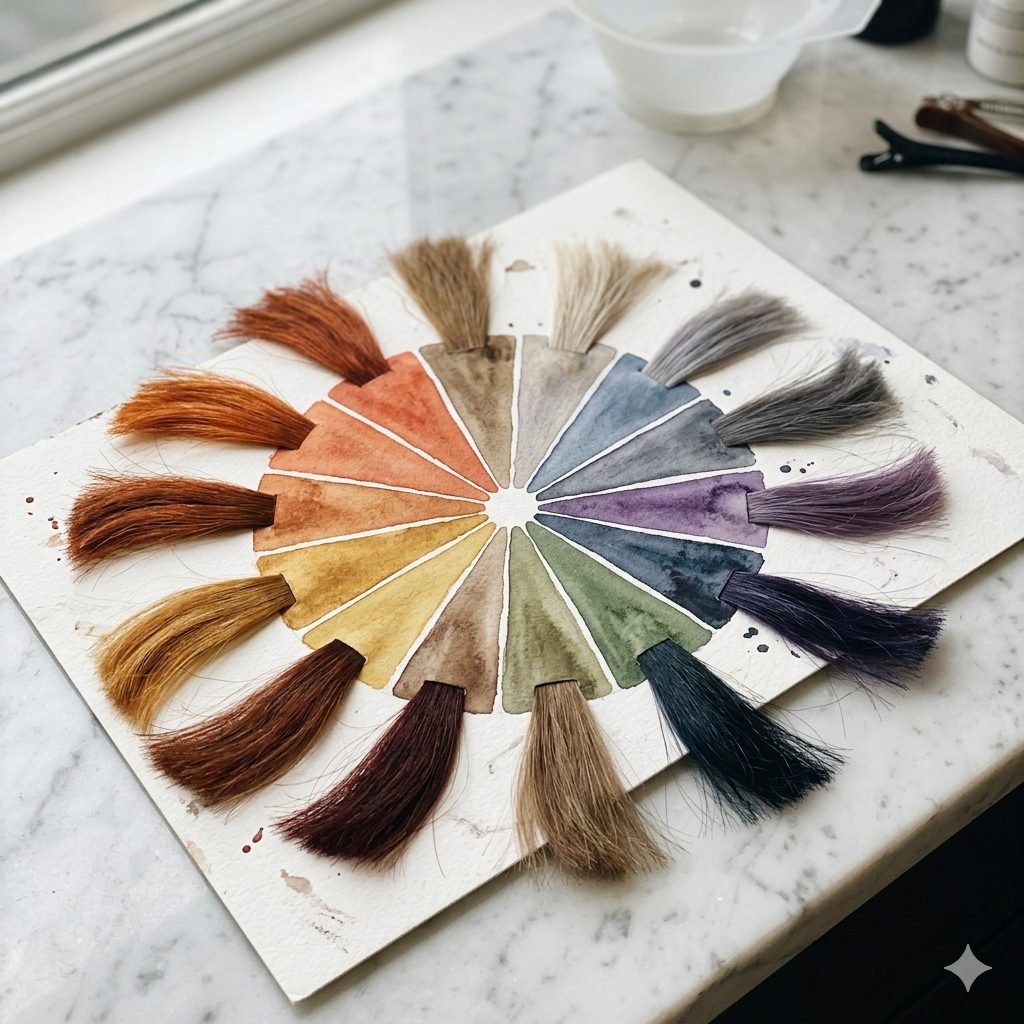
The colour wheel isn't just an art school concept, it's a precision tool for the colourist. It maps which colours sit opposite each other (complementary pairs), and complementary colours, when mixed in equal proportions, neutralise each other to a neutral brown or grey.
Primary and secondary colours
The three primary colours, red, yellow, and blue, cannot be created by mixing other colours. The three secondary colours come from combining two primaries:
- Red + Yellow = Orange
- Yellow + Blue = Green
- Red + Blue = Violet
Each of these sits directly opposite its complementary on the wheel, creating the neutralising pairs every colourist must know by instinct.
Neutralisation reference table
| Unwanted reflect | Neutralising colour | Typical salon application |
|---|---|---|
| Yellow | Violet / iridescent | Brassy blonde after bleaching, toning yellow-straw highlights |
| Orange | Blue / ash | Copper highlights, faded balayage on light brown bases |
| Red | Green / matt | Softening persistent red tones on brunette bases |
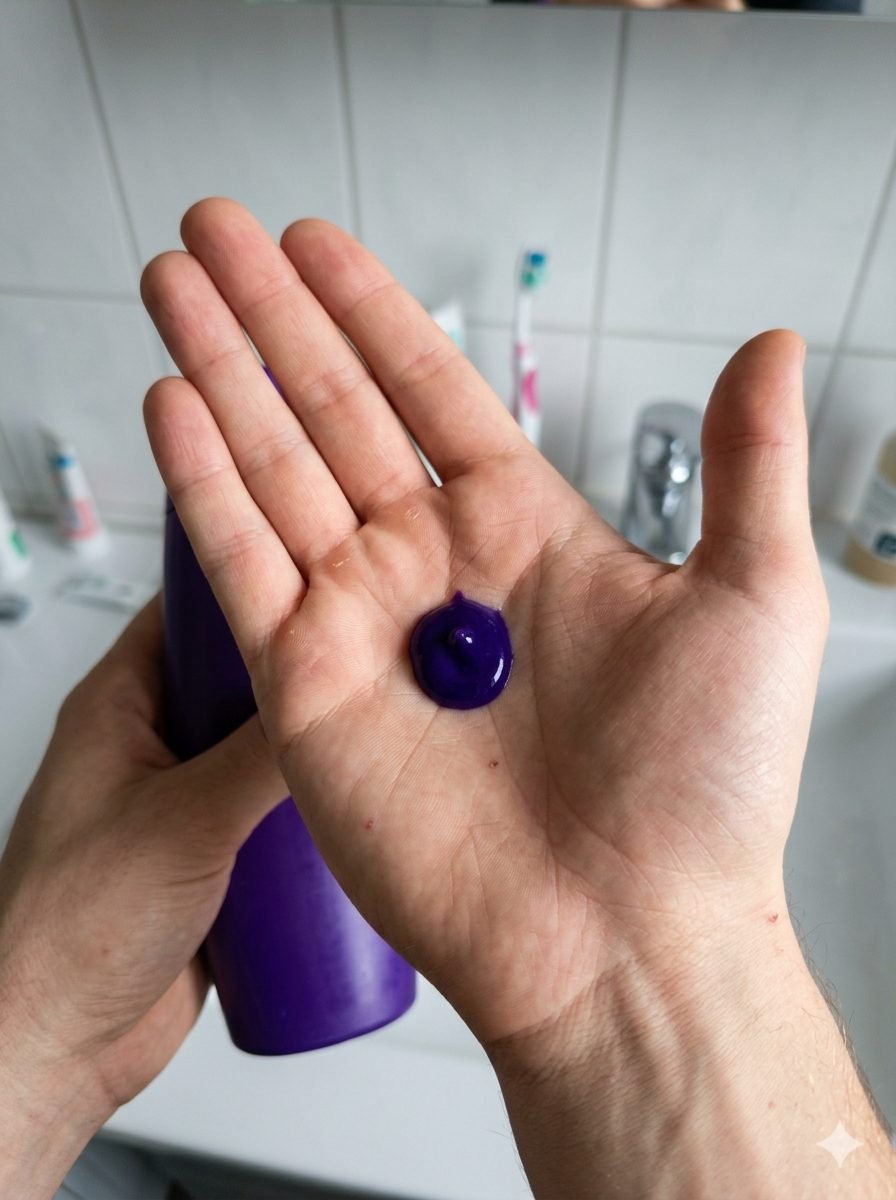
You apply this principle in two ways: by incorporating the neutralising reflect directly into your colour formula (e.g. adding an ash /1 to a blonde to prevent warmth), or by recommending at-home maintenance products, purple shampoo for yellow tones, blue shampoo for orange tones.
International reflect codes (0–7)
The numbering system on a colour tube follows an internationally agreed format. The number before the decimal or slash indicates the depth level (how light or dark), while the digits after indicate the reflects, first the dominant, then the secondary.
Reflect code reference chart
| Code | Reflect name | Description |
|---|---|---|
| 0 | Natural | No dominant reflect, neutral result |
| 1 | Ash | Blue-green dominant, cool and matte |
| 2 | Iridescent / Violet | Violet dominant, neutralises yellow |
| 3 | Golden | Yellow dominant, warm and luminous |
| 4 | Copper | Orange dominant, intense warm tone |
| 5 | Mahogany | Red-violet, deep and rich |
| 6 | Red | Pure red, vivid and saturated |
| 7 | Matt / Brown | Green-brown, muted natural tone |
Reading a full colour code
Take 7.34 as an example:
- 7 = depth level (medium blonde)
- 3 = dominant reflect (golden)
- 4 = secondary reflect (copper)
The result: a medium blonde with a warm golden base and a copper accent. A doubled reflect digit, such as 8.22, signals an intensified version of that reflect (very strong violet/iridescent, ideal on highly yellow bases). Some brands use a slash instead of a decimal, but the logic is identical.
Want to understand how to match colour tones to your client's seasonal colour type? Read our guide to colour analysis and hair colouring.
Mixing formulas and developer strength
Calculating a blended reflect
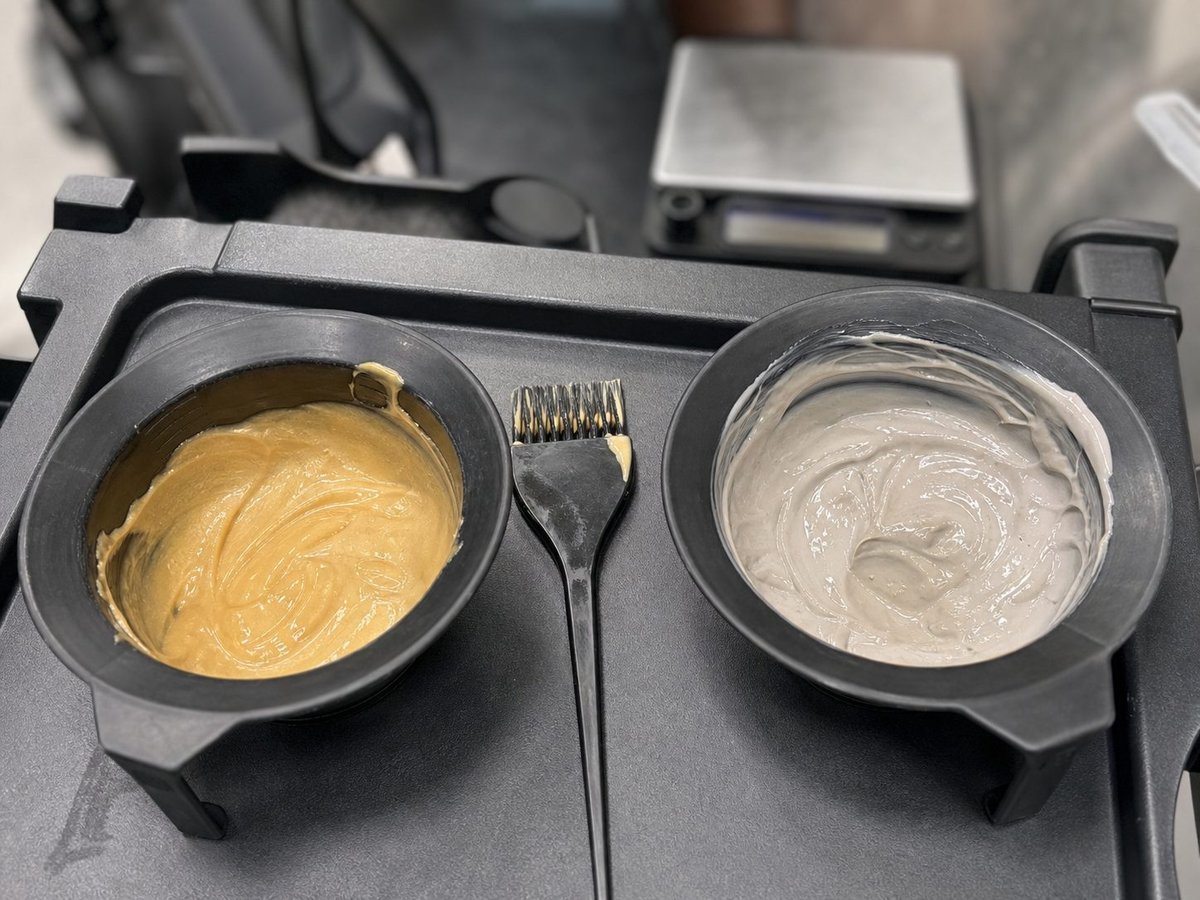
When you mix two shades of the same depth but different reflects, the resulting reflect is calculated proportionally:
Formula: [(Reflect A × quantity A) + (Reflect B × quantity B)] ÷ total quantity
Example: 30g of 7.3 (golden medium blonde) + 20g of 7.1 (ash medium blonde):
- Hair colour hairdresser : [(3 × 30) + (1 × 20)] ÷ 50 = (90 + 20) ÷ 50 = 2.2
- Result: approximately 7.22, medium blonde with a dominant iridescent/violet reflect and a golden warmth underneath
Choosing the right developer
| Concentration | Volume | Lift effect | Effect on reflects |
|---|---|---|---|
| 3% | 10 vol. | None (tone on tone) | Maximum reflect intensity |
| 6% | 20 vol. | 1–2 levels lighter | Reflects clearly visible |
| 9% | 30 vol. | 2–3 levels lighter | Reflects diluted by lift |
| 12% | 40 vol. | 3–4 levels lighter | Reflects significantly reduced |
Tip: if you want to maximise reflect saturation while still gaining lift, use 20 volume with a slightly extended processing time rather than jumping to 30 volume, which will dilute the pigment deposit noticeably.
Three common salon scenarios
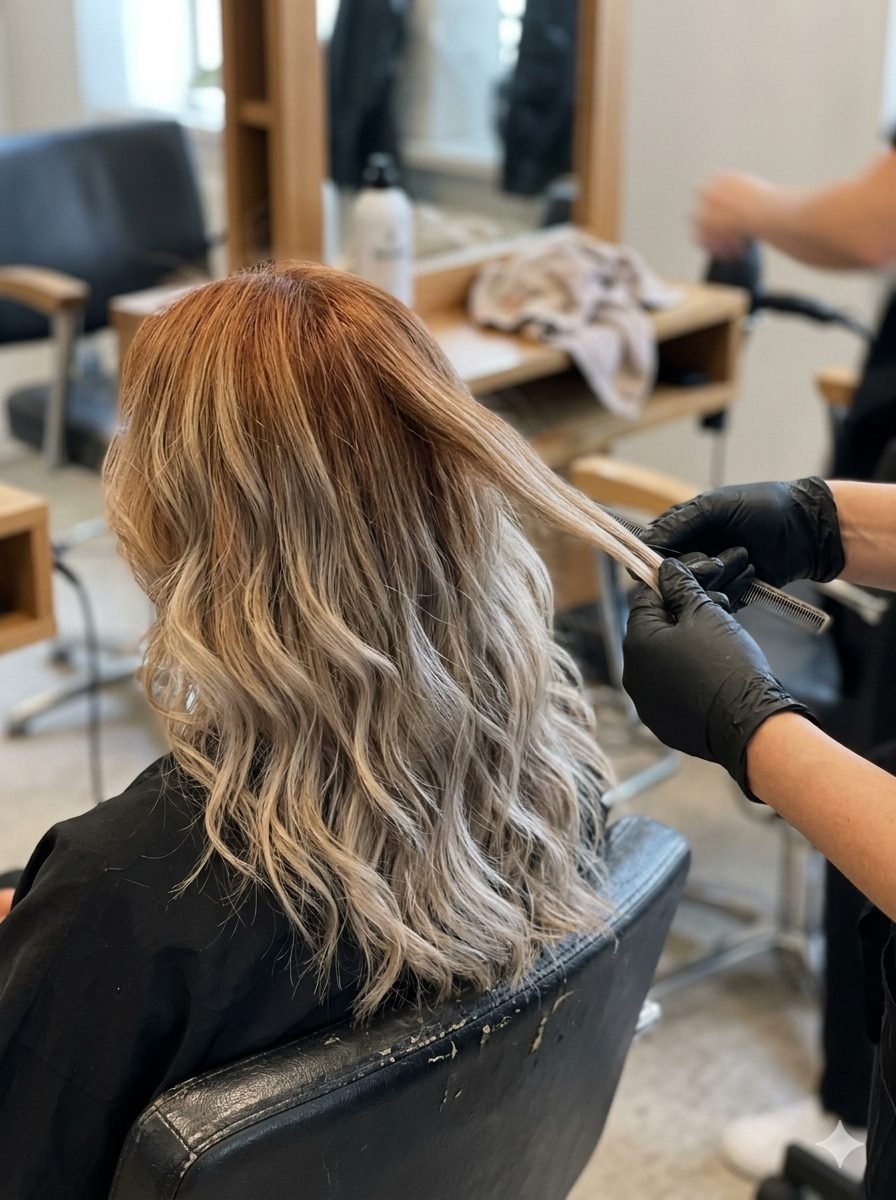
Scenario 1, Brassy balayage on a light brown base
Situation: A client returns with balayage applied 10 weeks ago on a natural level 5 (light brown) base. The highlighted sections have turned orange. She originally wanted an ash blonde result.
Colour diagnosis: The bleach stopped at the orange underlying pigment (levels 5–6). Applying an ash tone directly onto that orange base would yield a murky, greenish result, blue + orange = dull grey-brown.
Protocol:
- Pre-lighten the highlighted sections to levels 8–9 (pale yellow underlying pigment)
- Apply a level 9 colour with ash (/1) or iridescent (/2) reflects to neutralise any residual yellow
- Prescribe a purple shampoo for weekly at-home maintenance
« Just had a salon balayage and the end result was far too yellow with brassy tones, it just looks like I have copper highlights with bleached blonde highlights, just doesn't look good. »
Common mistake: Applying a cool tone directly over an orange base. This is the most frequent cause of grey-green results on UK colour corrections.
Scenario 2, Going brunette from heavily bleached hair
Situation: Heavily bleached hair (levels 9–10). The client wants to go back to a natural dark blonde (level 6). She's read online that ash tones look most natural.
Colour diagnosis: Bleached hair at levels 9–10 has lost all its warm pigment. Adding a cool (ash/blue-green) reflect onto a warm-pigment-free, cold base produces green tones.
Protocol:
- Pre-pigmentation first: apply a level 6 golden (/3) or copper (/4) colour diluted 50:50 with conditioner. Process 15 minutes without heat.
- After 48 hours: apply the final level 6 natural (/0) or softly golden-natural (/03) with 10 volume developer.
Rule: Always rebuild warm pigment before going darker on heavily bleached hair. The underlying pigment chart tells you exactly which warm tones have been removed.
Scenario 3, White hair coverage on a mixed base
Situation: Approximately 60% white hair on a natural level 5 base. Target: a uniform, fully covering medium brown.
Colour diagnosis: White hair has zero pigment, it is the equivalent of level 10. It requires a higher pigment load to saturate the empty cortex effectively.
Protocol:
- Use a level 5 natural (/0) colour at a 1:1 ratio with 20 volume developer (rather than the standard 1:1.5)
- Add 10–15% of a golden (/3) shade to boost pigment saturation and coverage reliability
- Extend processing time by 5 minutes beyond the manufacturer's standard recommendation
Find professional colour analysts and colourists across the UK on our directory of colour consultants.
Fixing colour mistakes
Problem 1, Hair turned orange after bleaching
Cause: Bleach lifted to levels 5–6 (orange underlying pigment) when the target required levels 8–9 (yellow underlying pigment).
Solutions:
- Repeat bleach immediately (if hair condition allows): 20 volume developer, monitor every 5 minutes
- Colour correction: Apply a level 7 shade with ash-iridescent reflects (/12) to partially neutralise the orange and deliver a wearable dark blonde result
- Blue gloss: For fragile hair, 5–10% blue semi-permanent in a neutral conditioner, 20 minute processing time
« The pic was a balayage with the coloured bits being dirty blonde and the hairdresser turned my hair orange. I was too scared to say anything. »
Problem 2, Green tones on bleached hair
Cause: Cool (ash) reflect applied on a base stripped of all warm pigment, or chlorine exposure from a swimming pool.
Solutions:
- Warm colour bath: 1 part golden colour (level 8-9, /3) + 2 parts conditioner + 1 part 10 volume developer. Process 10 minutes at room temperature.
- Clarifying shampoo method: Mix a clarifying shampoo with a small amount of bleach powder (1:1) and apply to dry hair for 5 minutes to strip surface green deposits
- Apple cider vinegar rinse: 1 part ACV + 3 parts water applied after shampooing closes the cuticle and removes superficial chromatic deposits
« It got progressively worse and more orangey-yellow with each session, no one had explained that an ash toner applied on an orange base would just go muddy. »
Problem 3, Colour too dark or over-saturated
Cause: Incorrect base assessment, over-processing, or wrong developer concentration.
Solutions:
- Colour remover within 48 hours: Oxidative colour remover (available from professional suppliers such as Ugly Duckling or Colour Restore) breaks artificial pigment bonds without affecting natural melanin
- Repeated clarifying washes: 3–4 clarifying shampoos applied consecutively on dry hair to extract surface pigment
- Oil pre-treatment: Apply warmed coconut or argan oil under cling film for 1–2 hours before colour removal, oil penetrates the cortex and helps mobilise pigment molecules
Before reaching for the colour chart, understand which tones naturally complement your client's skin undertone. See our guide to finding the most flattering colour for your complexion.
Frequently asked questions
What does the number on a hair colour tube mean?
The first number (before the decimal or slash) is the depth level, how light or dark the colour is, from 1 (black) to 10 (platinum). The digits after indicate the reflects: the first is the dominant reflect, the second is the supporting reflect. So 6.34 is a dark blonde (level 6) with a dominant golden reflect (3) and a secondary copper note (4).
What colour cancels orange in hair?
The complementary colour of orange on the colour wheel is blue. In practice, this means using a shade with an ash (/1) reflect, a blue semi-permanent toner, or a blue shampoo to neutralise unwanted orange tones. Crucially, neutralisation only works when the hair is light enough, on a level 5–6 orange base, you need to pre-lighten further before toning will deliver a clean result.
Why did my hair go orange after bleaching?
The bleach process stopped at the orange underlying pigment stage (levels 5–6). At that point, the larger eumelanin granules have been oxidised but the smaller pheomelanin molecules remain. Reaching a true pale blonde requires lifting to levels 8–9, where the underlying pigment becomes a compatible yellow. If the hair is too damaged to lift further, a blue gloss can soften the orange tone as an interim solution.
Can you mix two different hair colour reflects?
Yes, this is standard practice for creating bespoke shades. Use the weighted average formula: [(Reflect A × quantity A) + (Reflect B × quantity B)] ÷ total. Always mix shades of the same depth level and use the manufacturer's recommended developer ratio. Custom blending is particularly valuable for matching a client's existing colour or creating a graduated warmth across a formula.
What is pre-pigmentation and when is it needed?
Pre-pigmentation means reintroducing warm pigment (golden or copper tones) into heavily bleached hair before applying a darker colour. It is essential whenever you go darker from levels 9–10, or whenever you want to avoid green or drab results when returning to brunette shades.
Conclusion: colour charts as everyday tools
The depth scale, underlying pigment chart, colour wheel and reflect codes together form a complete technical vocabulary for the professional colourist. Used consistently, they transform colour work from guesswork into a predictable, repeatable craft, one where your clients can trust that what they ask for is what they'll receive.
Print these charts, keep them at your station, and build your own formula library over time. The most valuable reference you'll ever have is your own record of what worked, on which base, with which products. For further study, the Sally Beauty UK shade chart is a useful complement to this guide.
If you'd like to explore the broader world of personal colour analysis, matching clothing and cosmetics to your client's natural colouring, visit our colour analysis guides and resources.